




Two Metals, Two Roles in 2026
Spot gold has been around 5,000 USD/oz in mid-February, roughly 70-75% higher than a year ago after a recordbreaking 2025. Silver has risen even faster, with 2025 delivering gains of about 140–150% and it has remained extremely volatile into early 2026. For UK investors, the question is no longer whether to choose gold or silver, but how much of each metal to hold and what specific role each should play within a broader portfolio.
How Gold and Silver Have Performed
Recent performance sets the tone for how investors perceive risk in each metal. Gold rose about 65% in 2025, its strongest annual growth since 1979, with gains driven by centralbank buying, inflows into goldbacked products and expectations that interest rates would eventually fall. In early 2026, gold is trading around 5,000 USD/oz and is roughly 75% higher than it was a year earlier, which reinforces its status as a strategic asset rather than a shortterm trade.
Silver, by contrast, gained roughly 140–150% in 2025, breaking through longstanding resistance levels and ending the year at more than double its starting price. In early 2026, silver has seen very large swings; by mid-February it was around $77-$82/oz, still dramatically higher than a year earlier. This pattern underlines a key practical difference: gold’s move has been powerful but comparatively smooth, while silver’s rally has been more explosive and volatile.
Gold’s performance has been driven by strategic reallocations from central banks, institutions and longterm investors who are responding to concerns about inflation, debt and geopolitical risk. Silver’s surge reflects both monetary demand and a structural squeeze from industrial uses, particularly in solar panels, electronics and other technologies linked to decarbonisation and electrification.
Different Drivers, Different Personalities
Gold and silver respond to overlapping but distinct forces, which gives each metal a different “personality” in a portfolio. Gold functions primarily as a monetary metal. It is held by central banks and longterm investors as a hedge against currency debasement, inflation and systemic risk, and is often viewed as an insurance asset that does not depend on the solvency of a bank or government. Its price tends to move most strongly when confidence in fiat currencies or financial markets is under pressure, and its industrial demand is relatively small, which helps keep its behaviour focused on macroeconomic and geopolitical themes rather than business cycles.
Silver, on the other hand, sits between the worlds of money and industry. It has a long history as a monetary metal but today a large share of demand comes from industrial sectors such as photovoltaics, electronics, automotive applications and other greentechnology uses. Those industrial links mean silver can benefit from global growth and the energy transition, but they also make it more cyclical and sensitive to changes in manufacturing activity and investor risk appetite. As a result, silver typically exhibits much larger daytoday and weektoweek price swings than gold, which can be attractive for opportunity seekers but more challenging for conservative holders.
Which Metal Suits Which Type of Investor?
Thinking about roles can be more helpful than thinking in terms of “better” or “worse”. Gold tends to suit investors who want a longterm store of value and an inflation hedge rather than a shortterm speculative position. These investors usually prefer smoother price behaviour and are more concerned with preserving purchasing power over many years than with maximising returns over a few months. For them, gold often serves as a core allocation that they expect to hold across multiple economic cycles, sometimes framed as a modest percentage of overall wealth, while recognising that anyone seeking specific allocations should obtain personalised financial advice.
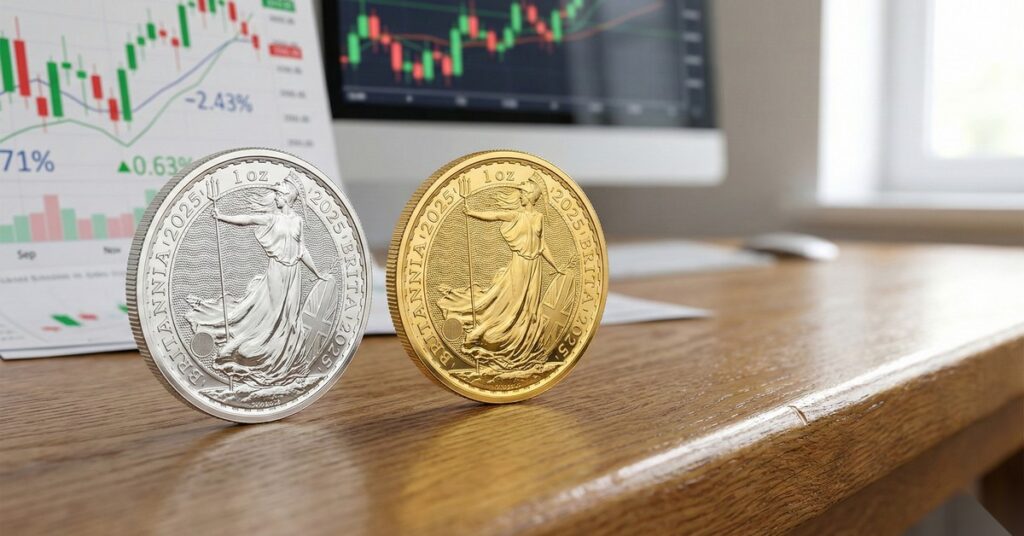
In UK practice this frequently translates into gradually building positions in Sovereigns and Britannias, especially because of their tax advantages, alongside 1 oz or larger bars where investors want the lowest possible premiums for larger tickets. These formats are familiar, liquid and widely recognised, which makes them suitable for people who view gold as financial insurance and intend to hold for the long term.
Silver tends to appeal more to investors who are comfortable with higher volatility in exchange for greater potential upside. These individuals accept that the price can move sharply both up and down and plan to ride out corrections rather than reacting to every shortterm fluctuation. They are often attracted to the idea of combining silver’s monetary role with exposure to structural themes such as solar power and electrification, but they prefer to express that view through a tangible asset rather than through shares or funds. In this context, popular choices include 1 oz silver Britannias, 10 oz bars and 1 kg bars, where the lower unit cost compared with gold allows investors to scale in and out more flexibly over time.
Tax and Product Considerations for UK Investors
For UK investors, tax treatment and product choice are just as important as price charts. One major practical difference is VAT: physical silver delivered in the UK is generally subject to 20% VAT, while qualifying gold is VAT-exempt. UKlegaltender gold coins such as Britannias and Sovereigns are treated as sterling currency and are therefore exempt from Capital Gains Tax for UK residents, which can make a substantial difference for those holding over many years in a rising market. In contrast, bullion bars and most foreign coins can be subject to CGT if an investor’s gains exceed their annual allowance, meaning that the same price move may have different tax consequences depending on the format chosen.
Many UK buyers therefore use CGTexempt coins as their primary vehicle for gold and increasingly for silver and then add bars when they specifically want to minimise premiums per gram or per ounce on larger orders.
Putting It Together: A Blended Approach
In 2026, a growing number of investors are using gold as an anchor allocation and silver as a highergrowth, highervolatility satellite holding around that core. A simple, nonadvisory way to think about this is that the core of a preciousmetals position might consist of gold coins held for longterm wealth preservation and tax efficiency, while silver coins or bars sit alongside as a smaller allocation for those who are comfortable with sharper price movements and who want the potential for outsized gains.
