



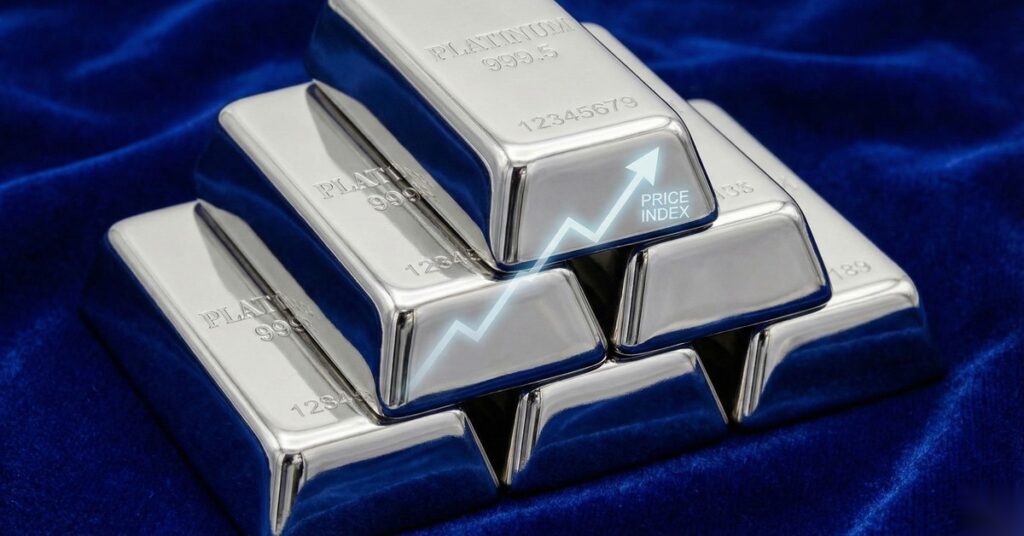
Platinum has kicked off 2026 with a remarkable surge, turning what is usually a quieter corner of the preciousmetals market into one of the early stories of the year. Prices have broken decisively higher on the back of tight physical supply, firm industrial demand and a growing sense among investors that platinum deserves a closer look alongside gold and silver.
January’s powerful price move
Coming out of a strong finish to 2025, platinum has moved into a fullblown rally through January, with many price series now showing levels in the high 2,000s per troy ounce. Some CFD benchmarks and futures contracts have briefly traded up toward the 2,900 USD/oz area, setting new records for those instruments and underlining how quickly sentiment has swung in platinum’s favour. Over the month, this leaves the metal up by roughly 30–35% depending on the data source, while on a 12month view platinum is now well over 100% higher, with some references putting the yearonyear gain close to 150–200% versus early2025 levels.
Intraday trading has been lively. MidJanuary sessions already saw spot and CFD prices test, then clear, the 2,500 USD/oz region before pushing on into the second half of the month. For Gerrard Bullion’s clients used to seeing gold take centre stage, platinum’s recent behaviour has been a reminder that smaller, more specialised markets can move very quickly when fundamentals and positioning line up.
Structural deficits and shrinking stocks
Behind this price move sits a story that has been building for some time. Estimates from the World Platinum Investment Council (WPIC) and other analysts show the platinum market swinging into a deep deficit in 2023, with substantial shortfalls expected to continue through at least 2025. Those annual deficits are commonly described as being on the order of 0.85–1.0 million ounces, which is a significant gap for a market of this size.
These repeated shortfalls have eaten into aboveground inventories that once provided a comfortable buffer. Recent commentary suggests that available stocks have been drawn down markedly from their early2020s levels, leaving only a few million ounces of readily accessible metal if current trends persist. Different sources give different precise figures, but the direction is the same: there is much less slack in the system than there was just a few years ago.
Looking ahead, many outlooks still point to a structurally tight market. Current projections indicate that platinum is likely to remain in deficit or close to balance through 2026, with several forecasters expecting ongoing, though smaller, annual deficits later in the decade. Rather than quoting a single number, these are often described as “hundreds of thousands of ounces” a year, or a lowsingledigit share of expected demand, assuming no major surprises in mine investment or technology changes.
Supply constraints: mines and recycling
On the supply side, the picture remains challenging. South Africa, which still accounts for roughly 70–75% of global primary platinum production, continues to grapple with power issues, ageing infrastructure and rising costs. Together, these factors limit how quickly production can respond, even when prices are attractive, and the pipeline of new projects remains thin and slowmoving.
Secondary supply is not picking up the slack to the extent it has in previous cycles. Recycling flows from spent auto catalysts, historically a key source of additional metal, have yet to return to their earlier peaks, reflecting changes in the makeup of the vehicle fleet, scrappage patterns and the hangover from earlier declines in diesel demand. For now, that leaves both primary and secondary supply struggling to keep pace just as more investors start paying attention to platinum’s fundamentals.
Demand drivers: autos, industry, jewellery
Demand remains anchored by three main pillars: automotive use, industrial applications and, increasingly, investor interest. In the automotive sector, tighter emissions rules have kept catalyst loadings elevated, while a major wave of platinumforpalladium substitution in gasoline catalysts over recent years has locked in higher platinum use on a number of engine platforms. The pace of new substitution has slowed as palladium prices have moved closer to platinum, but the changes already made continue to support demand from carmakers.
The shape of the vehicle market is also working in platinum’s favour. Full batteryelectric vehicle adoption has been slower than some earlier forecasts suggested, while hybrid models – which still rely on PGMs in their exhaust systems – have grown their share. That has kept internalcombustion and hybrid output at levels that continue to generate solid catalyst demand.
Industrial users form another important strand of the story. Platinum is used in a wide range of chemical and refining processes, and it is gaining visibility in fuel cells and emerging greenhydrogen technologies. This links platinum not just to traditional industry but also to longerterm themes around decarbonisation and energy transition, which is something we regularly discuss with Gerrard Biullion’s clients looking further down the road.
Jewellery demand is more cyclical but still relevant. In parts of Asia in particular, high gold prices and platinum’s relative value appeal have encouraged some buyers to revisit platinum for certain styles and occasions. The picture is mixed from market to market, but jewellery remains a useful supporting layer in the overall demand profile.
Investor interest and the macro backdrop
With prices breaking out to new highs, investor interest in platinum has picked up noticeably. Market commentary and research notes have started to highlight platinum as a metal to watch in 2026, often pointing to the combination of structural deficits, a lean supply side and the potential for a rerating relative to gold and palladium. We are seeing more clients ask where platinum might fit alongside their existing gold and silver holdings, whether through physical investment, coins and bars, or exposure via other instruments.
The broader backdrop for precious metals remains supportive. Geopolitical tensions, an uneven global growth outlook and bouts of financialmarket stress have kept demand for defensive and diversifying assets elevated, not just for gold but across the complex. Markets are still debating the path of interest rates, with many investors expecting the possibility of easier monetary policy over the coming quarters and recognising that inflation risks have not entirely gone away. In that setting, platinum offers a way to diversify across metals while keeping exposure to a metal closely linked to realworld industrial activity.
What this means for Gerrard Bullion’s clients
For investors considering platinum today, the picture is a blend of opportunity and risk. A run of sizeable deficits, constrained mine supply and resilient industrial demand make a solid case for platinum as part of a diversified preciousmetals allocation, even after its strong start to 2026. At the same time, the speed of the recent rally means volatility is likely to remain elevated, and sharp pullbacks are always possible if the macro backdrop changes or sentiment cools across precious metals more broadly.
Most mediumterm forecasts still point to a market that stays tight, though not quite as extreme as the 2023–2025 period, as higher prices gradually encourage more mine investment and recycling while curbing some of the more pricesensitive demand. For UKbased investors, platinum can sit alongside gold and silver as an additional source of diversification, combining the characteristics of a precious metal with demand rooted in global industry, automotive production and the evolving energy transition.
