




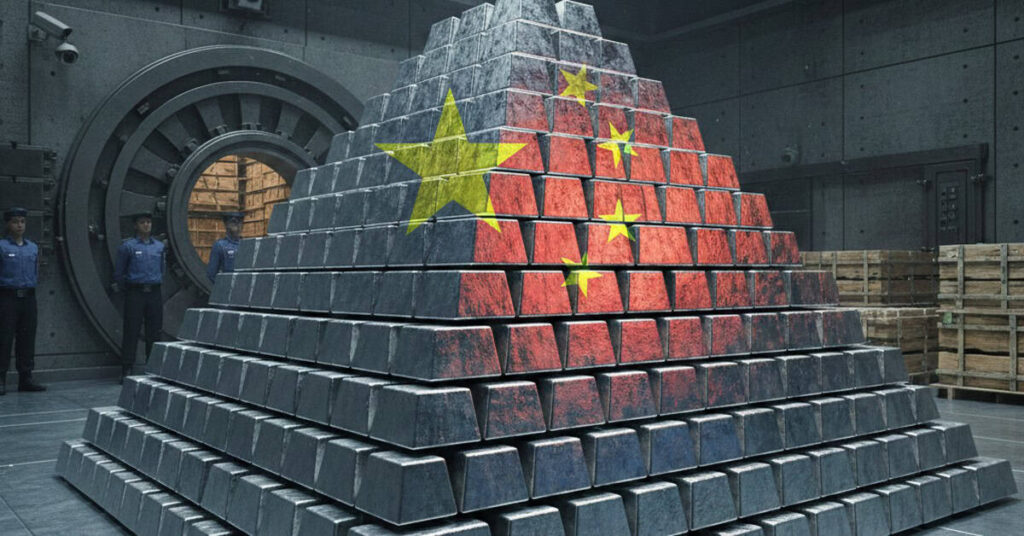
China’s decision to clamp down on silver exports from the start of 2026 marks one of the most important structural shifts the metal has seen in years. It arrives at a time when the global silver market was already running hot, grappling with chronic deficits and fast-growing industrial demand. For UK bullion investors, this is not just an abstract policy move happening thousands of miles away in Beijing; it helps to explain why silver prices have broken into a higher, more volatile range. It also highlights why portfolio decisions around silver now need to factor in geopolitics and resource nationalism just as heavily as traditional supply-and-demand metrics.
What Exactly Has China Changed?
From 1 January 2026, silver has been effectively shifted in China from the category of an ordinary industrial export to what is now a “strategic” material. Shipments abroad are no longer subject to routine customs formalities but are instead bound by a strict licensing regime. Only a select group of roughly forty-four companies has been authorised to export silver for the 2026–27 period. This means that most of the refined metal leaving the country will now flow through a tightly controlled channel that authorities can open or narrow as their policy priorities dictate. Analysts estimate that because China dominates silver refining and plays such a central role in supplying the solar, electronics, and EV industries, these rules effectively place a very large share of internationally traded silver behind a regulatory gate. Crucially, this gate can be adjusted without the need to announce formal bans or provocative tariffs.
Strategic Motives and Market Interpretation
The official language surrounding the move stresses the need to secure domestic supply for strategic sectors and to prevent the “irrational” low-priced export of critical materials. This echoes the justifications used when China tightened controls on rare earths, gallium, and germanium in previous years. However, the majority of market commentators view the silver decision as part of a wider “resource-nationalist” strategy. This approach gives Beijing additional leverage in its ongoing trade and technology disputes with the United States and Europe. In practice, the licensing system gives officials the power to slow approvals, concentrate export rights in the hands of state-aligned firms, or quietly nudge minimum export prices higher. They can do all of this without needing to publish headline-grabbing embargoes that might trigger immediate retaliation.
A Tight Market Meets New Controls
The timing of these measures is especially potent because the silver market was already tight before any new rules appeared on the statute book. Recent studies from industry bodies and research houses point to a string of annual supply deficits, shrinking visible inventories, and increasingly inelastic demand. This demand is coming from all sides: solar panel manufacturers, datacentre and AI infrastructure builders, and the broader electrification and EV complex. Against that backdrop, the prospect that China may at any point choose to retain more silver for domestic use – or to modulate export flows – has been quickly interpreted as a powerful, structural bullish factor. It suggests that prices could stay higher for longer than in past cycles, supported by a supply chain that is now far more vulnerable to political intervention.
Price Action: Volatility Around a Higher Base
Price action around the announcement and implementation has already reflected this new reality. In the weeks leading up to 1 January 2026, international silver prices surged to record or near-record levels. Some trading sessions were characterised by sharp intraday spikes as traders scrambled to secure exposure ahead of the rule change.
Subsequent pullbacks have been steep at times, driven in part by profit-taking and forced liquidations in leveraged futures positions. However, commentary has consistently noted that these corrections have not been accompanied by any meaningful easing in the underlying physical tightness. The emerging consensus is that, in the short term, investors should expect a more jagged price path with larger swings in both directions. Yet, these swings are likely to be anchored around a higher average level than prevailed before the policy shift.
The Medium-Term Outlook
Looking a little further out, many banks, brokers, and specialist precious-metals analysts see China’s export regime as accelerating trends that were already in place, rather than creating an entirely new story from scratch. Multi-year under-investment in new mines, rising environmental constraints, and the sheer scale of expected silver use in solar, semiconductors, and electric vehicles were already feeding arguments that silver should trade more like a strategic input to the energy transition than a mere by-product metal. By adding a powerful policy lever on the supply side, China has, in the view of many commentators, created the conditions for a higher “normal” trading band. This band will likely be punctuated by occasional squeezes when macro shocks or extra demand collide with constrained export flows.
There are, of course, more cautious voices. A minority of analysts argue that if silver prices remain elevated for an extended period, they will eventually draw out new mine supply in jurisdictions outside China. High prices may also encourage substitution in some industrial uses and stimulate a greater focus on recycling, particularly from end-of-life solar panels and electronics. On this view, the export controls may prove most powerful over a two-to-five-year horizon, after which the market could adapt and rebuild some resilience, potentially capping further dramatic upside.
Even these more measured takes, however, tend to accept that in the near and medium term, the changes are unequivocally supportive for prices. They reinforce silver’s status as a strategic asset in diversified portfolios, moving it beyond a simple commodity and into the realm of geopolitical strategy.
